
Exercise & movement
The closest thing we have to a longevity drug, broken into five kinds of fitness.
If exercise were a pill, it would be the most prescribed drug in the world. It acts on almost every hallmark of ageing, lowers the risk of heart disease, type 2 diabetes, several cancers, dementia and depression, and keeps you independent in old age. No other single habit comes close.
Fitness predicts lifespan
In a 2018 study of more than 120,000 people who took treadmill tests, those with the lowest cardiorespiratory fitness had around five times the risk of death of the fittest, a gap larger than that linked with smoking or diabetes. And there was no upper limit: the fittest group did best of all.
Strength tells a similar story. Grip strength, leg strength and the ability to get up off the floor without using your hands all predict how long, and how well, people live.
The five areas of fitness
Most people train the one they already enjoy. A runner runs, a lifter lifts. But you're only as fit as your weakest area.
- Strength. How much force you can produce. Protects bones, joints, metabolism and independence.
- Muscular endurance. How long you can keep working. Carrying shopping, climbing stairs, hiking.
- Speed & power. How fast you can produce force. The first to decline with age, and what stops a trip turning into a fall.
- Cardiovascular endurance. How well your heart, lungs and muscles deliver and use oxygen, measured as VO2 max.
- Flexibility & mobility. How freely you move through a full range. Keeps the other four usable.
The journal's fitness map has you test all five, score each from 1 to 5, and build your training around the two lowest.
What a good week looks like
The WHO minimum is 150–300 minutes of moderate activity a week (or 75–150 minutes of vigorous activity), plus strength training on two or more days. For longevity, a well-rounded week looks something like this:
| Type | How much | Example |
|---|---|---|
| Zone 2 cardio | 2–3 sessions, 30–60 min | Brisk uphill walk, easy cycling; you can still talk in full sentences |
| High intensity | 1 session | 4 × 4 minutes hard, with 3 easy minutes between |
| Strength | 2–3 sessions | Squat, hinge, push, pull, carry |
| Power & balance | a few minutes, most days | Jumps, fast step-ups, single-leg work |
| Daily movement | every day | 7,000–10,000 steps |
You don't need all of it on day one. Start with what's missing.
Steps still count
A 2022 analysis of 15 studies found that the risk of death fell steadily with more daily steps, levelling off at around 8,000–10,000 steps a day for adults under 60 and 6,000–8,000 for those over 60. For anyone starting from a low base, walking is the easiest win there is.
Sitting
Long, unbroken sitting carries its own risk, even for people who train. Stand up and move for a couple of minutes every 30–60 minutes. A short walk after meals also blunts blood sugar spikes.
Start where you are
If you've been inactive, begin with walking and two short bodyweight strength sessions a week, and build gradually, about 10% more each week. If you have a heart condition, get chest pain on exertion, or haven't exercised in years and have other risk factors, check with your doctor first.
Key numbers
~5×: the difference in mortality risk between the least fit and the fittest.
150–300 min: weekly moderate activity (WHO).
2+: strength sessions a week.
This week
- Test your five areas of fitness. The tests are on the Testing page and in the journal's fitness map.
- Add one strength session, even 20 minutes of squats, push-ups and rows.
- Walk for 10 minutes after your biggest meal on three days.
In the journal
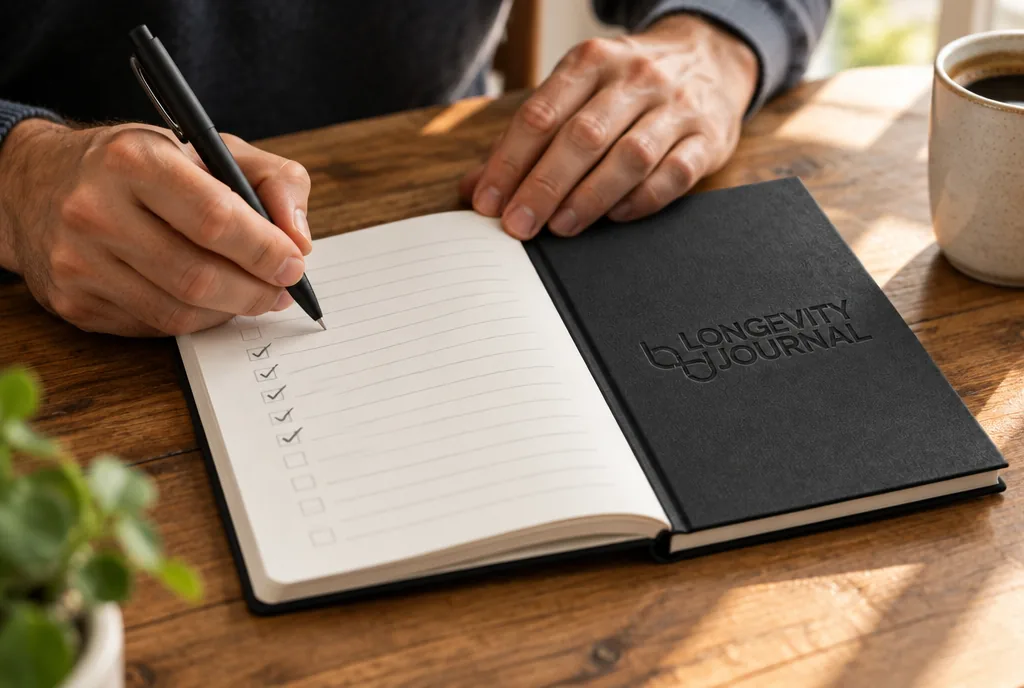
The "Exercise" box is judged against the exercise plan you write once, so it's a comparison, not a negotiation. Your fitness map, page 8, decides what goes in it.
Sources: Mandsager et al., JAMA Network Open 2018 · Paluch et al., Lancet Public Health 2022 · WHO Guidelines on Physical Activity and Sedentary Behaviour, 2020
 Put this chapter into practice — The Longevity Journal