Work, purpose & productivity
Having a reason to get up in the morning is measurable, and it shows up in the data.
You spend around a third of your adult waking life at work. It shapes your stress, your movement, your sleep, your relationships and your sense of who you are. And the question underneath it, whether your life has a purpose, turns out to matter for how long you live.
Purpose and longevity
In a study of nearly 7,000 American adults over 50, those with the weakest sense of purpose were more than twice as likely to die over the following years as those with the strongest, after adjusting for health and other factors. Similar findings come from Japan, where having ikigai, a reason for being, is linked with lower mortality and better cardiovascular health.
Purpose doesn't have to come from work. It can come from family, faith, community, a craft, caring for others or learning. What matters is having something that feels worth getting up for.
Work that doesn't cost you your health
Break up sitting. Stand and move every 30–60 minutes. Walking meetings, a standing desk for part of the day, and taking calls on your feet all count.
Protect deep work. Constant switching between tasks and notifications is exhausting and unproductive. Block 60–90 minutes for your most important work with notifications off. Most people get more done in two focused blocks than in a full distracted day.
Manage energy, not just time. Do demanding work when you're sharpest, often in the morning. Take a real break at lunch, ideally outside. Stop caffeine by early afternoon.
Define an end to the day. A shutdown ritual (review tomorrow's list, close the laptop, change clothes or go for a walk) helps your brain stop working when you do.
Watch for burnout. Exhaustion, cynicism about work, and a sense that nothing you do makes a difference are its three classic signs. Burnout is a signal to change something structural, not to try harder.
The retirement cliff
Retirement can be a health risk for people whose identity, routine and social life came from work. Plan for it: what will give your days structure, contact with people and a sense of purpose? The best time to build those is long before you need them.
The ONE thing
The single most useful productivity habit is deciding, each morning, the one thing that would make the day a success, and doing it first. It's simple, it's the core of the journal's morning page, and it works for health as well as work.
Key numbers
2×: the difference in mortality between the weakest and strongest sense of purpose in one large study.
30–60 minutes: the longest to sit without moving.
60–90 minutes: a good deep-work block.
This week
- Write one sentence: what gives your life purpose right now?
- Set a movement reminder every 45 minutes during work.
- Block one 90-minute deep-work session with notifications off.
In the journal
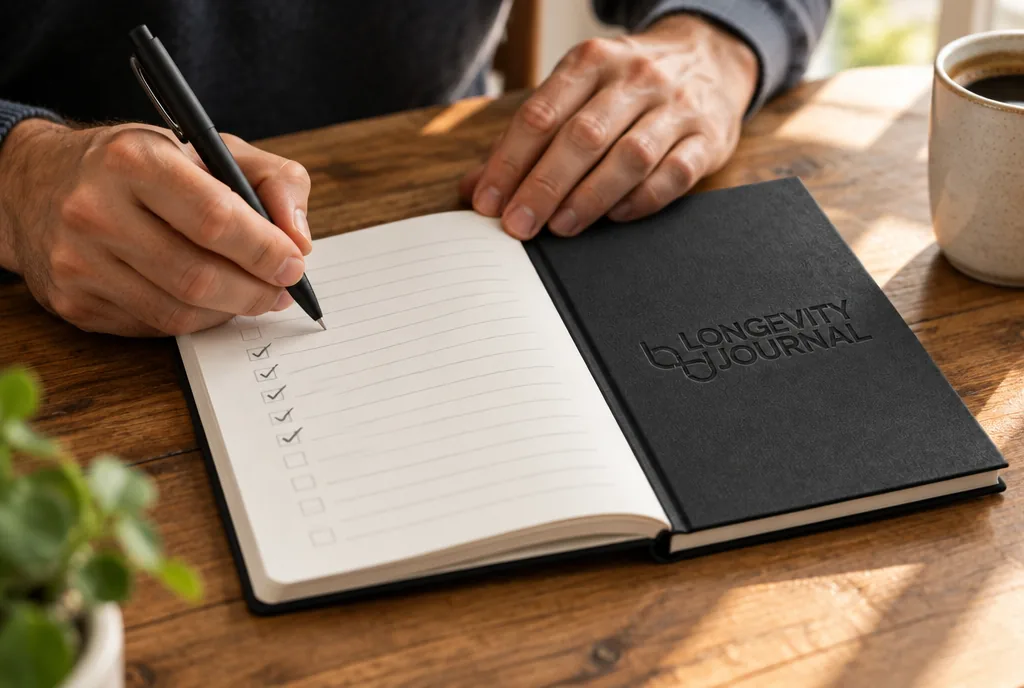
Your seven boxes are the ONE-thing habit, written down: seven small actions, chosen once, ticked every evening.
Sources: Alimujiang et al., JAMA Network Open 2019 · Sone et al., Psychosomatic Medicine 2008 · Maslach & Leiter, World Psychiatry 2016
 Put this chapter into practice — The Longevity Journal