
Sleep & circadian rhythm
The cheapest performance and longevity tool there is, and the one most people cut first.
Sleep is when your body does its maintenance. Muscles repair, memories consolidate, hormones reset and the brain clears waste products that build up during the day. Short-change it and nearly every other system in this course works worse: you'll be hungrier, weaker, more stressed, and worse at the decisions that make the other habits stick.
Sleep makes everything else work
Better sleep isn't the goal in itself. It's the foundation that makes every other marker easier to move. Short or poor sleep is linked with higher risk of heart disease, stroke, high blood pressure, type 2 diabetes, weight gain, depression, dementia, injuries and accidents. It also unsettles the hormones that run the rest of your body: cortisol, testosterone, oestrogen and insulin. Sleep loss rarely causes these problems directly. It disrupts the repair and regulation that happen overnight, and those disruptions ripple across organs and systems.
Nobody sleeps perfectly. A useful goal: sleep well on nine nights out of ten, and let the tenth go, whether it's a stressful week or a great night out. Protect the nine, and everything else in this course gets easier.
How much
Adults need 7–9 hours. Consistently sleeping less than 7 is linked with higher risk of heart disease, type 2 diabetes, obesity, depression and early death. Very few people genuinely thrive on 6; most who believe they do have simply got used to feeling tired.
Regularity matters as much as duration
A 2024 study of around 60,000 people wearing activity trackers found that sleep regularity, going to bed and waking at consistent times, predicted mortality more strongly than how long they slept. Weekend lie-ins that shift your clock by two hours act like a mini jet lag every Monday.
Pick a wake time you can keep seven days a week. It's the anchor everything else hangs on.
Your circadian rhythm
Your body runs on a roughly 24-hour clock, set mainly by light. Bright light in the morning tells it the day has started; darkness in the evening lets melatonin rise. Modern life gets this backwards: dim offices by day, bright screens at night.
- Morning light. 10–30 minutes outside within an hour of waking. Even overcast daylight is many times brighter than indoor light.
- Evening dark. Dim the lights two hours before bed. Warm, low lamps instead of overhead lighting.
- Screens. The content keeps you awake more than the blue light does. If you use a phone in bed, it's usually the scrolling, not the wavelength.
The biggest sleep disruptors
Caffeine has a half-life of about 5 hours, so half of a 3pm coffee is still in your system at 8pm. Stop caffeine 8–10 hours before bed.
Alcohol helps you fall asleep, then fragments the second half of the night and cuts deep and REM sleep. Even one or two drinks show up clearly on a sleep tracker.
Late meals raise body temperature and can cause reflux. Try to finish eating 2–3 hours before bed.
A warm room. Your core temperature needs to drop for you to fall asleep. Aim for a cool bedroom, around 17–19°C.
A racing mind. The most common reason people lie awake. A two-minute brain dump before bed, writing down everything on your mind plus tomorrow's first task, helps more than most people expect.
When to see a doctor
Loud snoring, gasping at night, morning headaches and daytime sleepiness despite enough hours in bed can be signs of sleep apnoea, which is common, under-diagnosed and treatable. Long-term insomnia is also treatable: cognitive behavioural therapy for insomnia (CBT-I) is the first-line treatment and works better long-term than sleeping pills.
Key numbers
7–9 hours: the adult target.
~5 hours: caffeine's half-life.
17–19°C: a good bedroom temperature.
This week
- Set one fixed wake time for all seven days.
- Get outside for 10 minutes within an hour of waking.
- Move your last coffee to before noon.
- Keep your phone out of the bedroom for three nights and notice the difference.
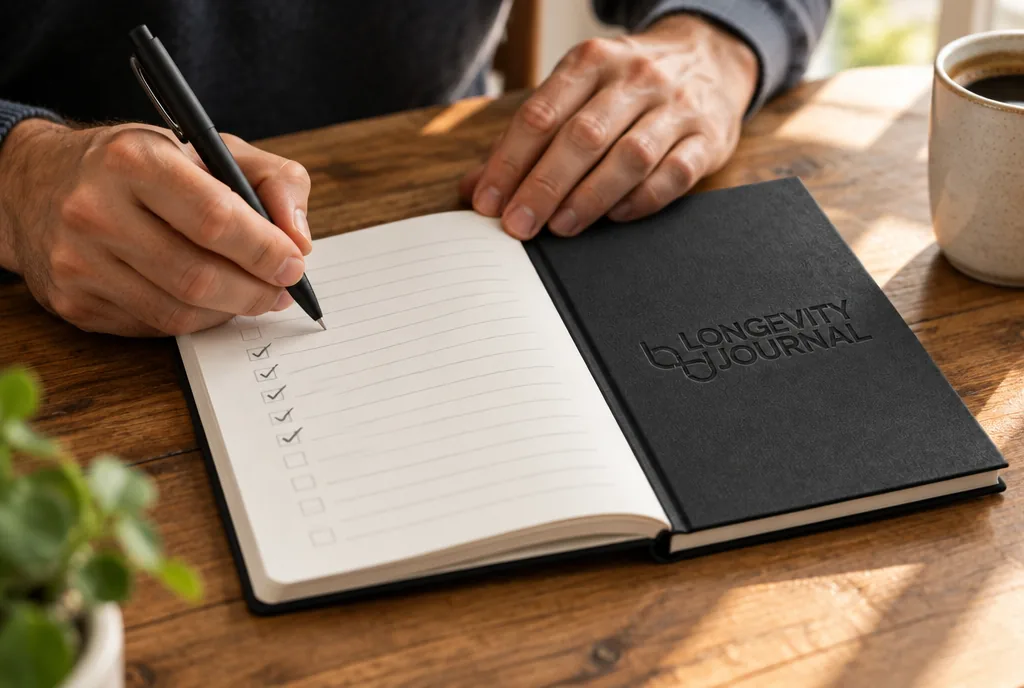
In the journal
"Sleep" is the first box on every evening page, and your bed and wake times go on your sleep plan, page 21.
Sources: Windred et al., Sleep 2024 · Watson et al., AASM/SRS consensus statement, Sleep 2015 · Edinger et al., AASM clinical practice guideline, Journal of Clinical Sleep Medicine 2021
 Put this chapter into practice — The Longevity Journal