
Testing

Fix the engine before the dashboard.

You are in the lowest level that still has a red box, and that box is the only thing worth working on. You do not buy your way up the levels. You earn your way up, one green box at a time.

Targets many longevity clinicians aim for, not diagnoses. Standard ranges are what most labs flag. Talk to your doctor before changing medication or if anything is far outside range.

The rule

  1. 01You are in the lowest level that still has a red box. That box is your bottleneck. Nothing above it counts for much until it is green.
  2. 02You move up from Foundational when every box has been green at two consecutive monthly checks. Two, not one: a single good month is a good month, not a change.
  3. 03Fix the engine before the dashboard. A perfect ApoB with a red blood pressure box is a dashboard reading on an engine you have not looked at.

Not all markers are equal

You could measure hundreds of things. A handful carry most of the signal. Start with these, and treat the rest as context.

Most signal

Pay attention to these first.

  • Blood pressureL1
  • Resting heart rate and HRV, against your own baselineL1
  • Waist, visceral fat and liver fatL1L3
  • VO2 maxL1L3
  • ApoB, and LDL particle count if offeredL2
  • HbA1c and fasting insulinL2
  • hs-CRPL2
  • Vitamin DL2
  • Bone density, from 50, or earlier with risk factorsL3

Worth knowing

They shift your risk, usually as contributing factors.

  • Liver enzymes: ALT, AST, GGT, ALPL2
  • Uric acidL2
  • Ferritin and ironL2
  • HomocysteineL3
  • Body fat %L1
  • Waist-to-hip ratio (context)L1
  • Testosterone and oestradiolL3

Context, not targets

Read them next to other results, ideally with someone who knows you.

  • Muscle mass and grip strengthL3
  • Thyroid hormones, SHBG, DHEAL3
  • Resting metabolic rate
  • Microbiome tests

Easy to over-read

On their own, they tell you less than they seem to.

  • Epigenetic age tests: vary between labs and between repeats
  • TSH on its own, without free T4
  • BMI: can't tell muscle from fat

The job isn't to measure everything. It's to find the one marker that reveals your biggest weakness, fix it, and retest.

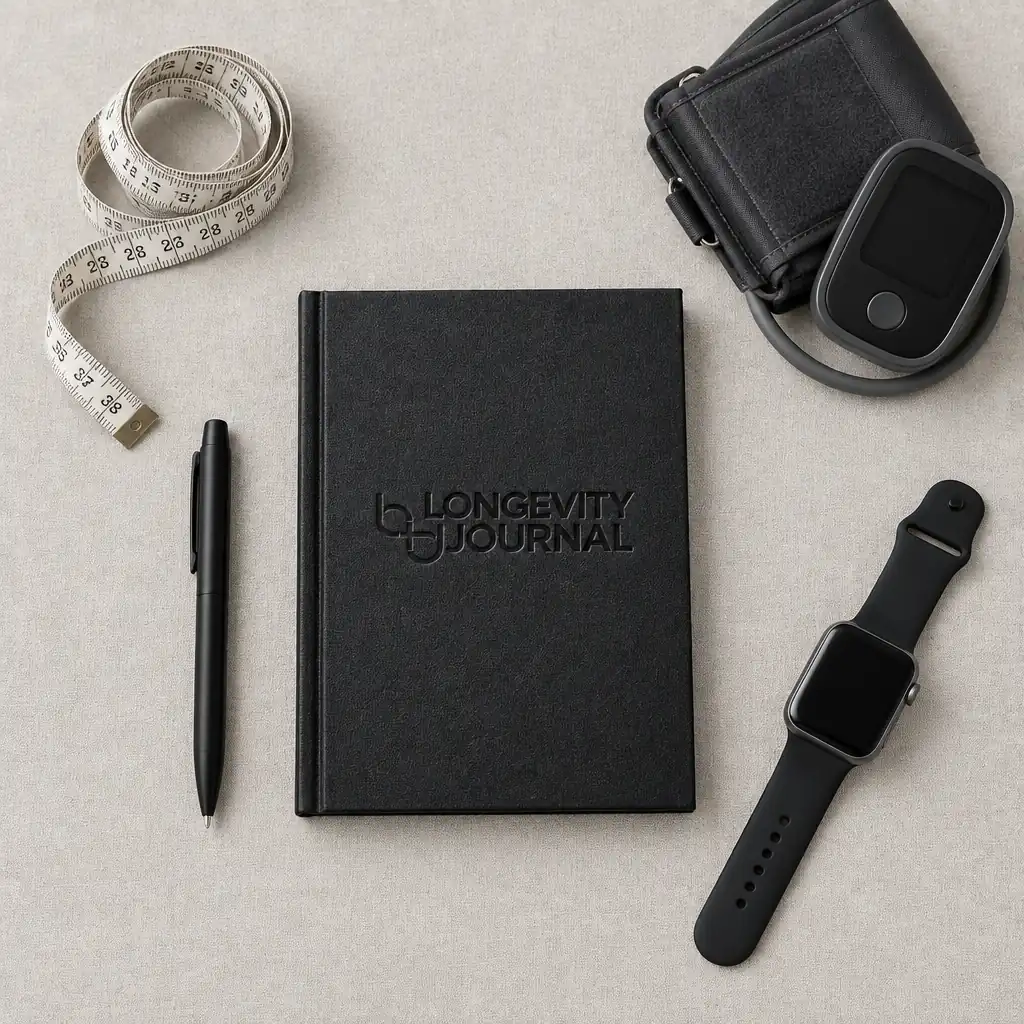
Flat lay of the journal with a tape measure, blood pressure cuff and pen, the Level 1 basics

Level 1 · Free, at home

Level 1 · Foundational

Lean, healthy and fit.

Be lean, healthy and fit before anything else. Everything here costs nothing but a tape measure, a blood-pressure cuff and a scale. Test on day 1, retest at every monthly check.

Metabolic health

  • Blood pressure

    Green target
    Below 130/85. Aim for 120/80.verify
    How to test
    Home cuff, seated, morning. Average of 3 readings on 3 days.

    The single largest modifiable driver of stroke and heart disease, and it has no symptoms.

  • Waist

    Green target
    Ratio below 0.50. Men below 94 cm, women below 80 cm.verify
    How to test
    Tape at the navel. Divide by your height.

    Where fat sits predicts metabolic risk better than weight or BMI.

  • Body fat

    Green target
    Men below 20 %, women below 28 %verify
    How to test
    Smart scale, same time of day before eating, or the tape formula calculator on this page.

    Separates fat from muscle, which weight and BMI can't.

Fitness

  • Resting heart rate

    Green target
    Below 70 bpm. Aim below 60.verify
    How to test
    On waking, before getting out of bed. Wearable or two fingers and a clock.

    Tracks fitness and recovery and moves within weeks of training.

  • Fitness map

    Green target
    Every area at 3 or higherverify
    How to test
    The five tests in the fitness map below.

    You are only as fit as your weakest area.

  • Sitting-rising test

    Green target
    8 out of 10 or betterverify
    How to test
    From standing, sit on the floor and stand back up. Start at 10: lose one point for each hand, forearm, knee or side of the leg used, half a point for any wobble.

    One score for lower-body strength, balance and mobility: the things that decide whether a fall happens.

The habits behind them

  • Daily steps

    Green target
    8,000 or moreverify
    How to test
    Phone or watch, 7-day average.

    Most of the mortality benefit of walking has landed by this point.

  • Sleep

    Green target
    7+ hours on at least 5 of 7 nights, regular bed timeverify
    How to test
    Hours asleep, and how regular your bed time is across the week.

    Short and irregular sleep moves glucose, appetite and blood pressure inside a week.

  • Smoking · alcohol

    Green target
    None · fewer than 5 drinks a week, never dailyverify
    How to test
    Honest count, including vaping. Count standard drinks across the week.

    Nothing else in this level moves lifespan as much.

Tape formula

No smart scale? Estimate body fat from a tape measure. All measurements in centimetres: neck below the Adam’s apple, waist at the navel.

Enter every measurement to see your estimate.

Your fitness map

Fitness has five areas. Most people train the one they're already good at. Test all five, score each 1–5, and build your training around the two lowest: you are only as fit as your weakest area.

AreaTest54321
StrengthMax strict push-ups in one go, scored by age and sexExcellentGoodAverageBelow averagePoor
Muscular endurancePlank hold on forearms, body straight≥ 3 min2 min90 s60 sLess
Speed & powerStanding long jump, two feet, land and holdMen ≥ 250 cm, women ≥ 200 cm220 / 175190 / 150160 / 125Less
Cardio enduranceCooper 12-minute run/walk, metres (women −200)≥ 2,8002,4002,0001,600< 1,600
FlexibilityStanding toe touch, knees straightPalms flatFingertips past toesToesAnklesShins

Age-and-sex tables: push-ups (Strength)

Minimum reps for each band. Below "Below average" is Poor. Excellent scores 5, Good 4, Average 3, Below average 2, Poor 1. Ages 18–29 use the 20s row; 70+ use the 60s row.

AgeExcellentGoodAverageBelow average
Men
20s39262212
30s3322189
40s2718157
50s2415125
60s2314103
Women
20s171083
30s16971
40s13751
50s11541
60s9531

Women's figures are converted from modified push-up norms, so treat them as approximate.

Bad knees, or not comfortable jumping? Do five sit-to-stands as fast as you can, arms crossed: under 10 s scores 3, under 8 s scores 4, under 6 s scores 5.

Score your fitness map

Enter your age and five results. Your last result stays on this device.

Enter your age and all five to see your map.

Optional: one-leg stand

A balance check, not a gate. Eyes open, arms free, shoes off: aim for 10 seconds or more on your worse leg.

Skin check: ABCDE

Once a month, in good light, with a mirror for your back. You are looking for a mole that is different from your others or different from how it looked last time.

  • Asymmetry — one half does not match the other.
  • Border — ragged, notched or blurred edges.
  • Colour — more than one shade, or colour that has changed.
  • Diameter — larger than about 6 mm, or growing.
  • Evolving — any change in size, shape, colour, or new itching or bleeding.
  • If two or more apply, see a dermatologist. This is not a box you wait a month on.

Moving up to Advanced

Every box green at two consecutive monthly checks. Then book your first blood panel.

Level 2 · One blood panel

Level 2 · Advanced

The basic blood panel.

Now that you're lean and fit, look inside. One blood panel, then again three months later.

Blood

Fasted, 10–12 hours, water only. The full reference panel is further down this page.

  • HbA1c

    Green target
    Below 5.4 %verify
    How to test
    Fasted blood panel

    Three-month average blood sugar. Moves slowly, which makes it honest.

  • Fasting glucose · insulin

    Green target
    70–90 mg/dL · below 6 µIU/mLverify
    How to test
    Fasted blood panel (ask for insulin by name)

    Insulin rises years before glucose does. The earliest warning you can buy.

  • Triglycerides · HDL

    Green target
    TG below 100 · HDL above 50 mg/dLverify
    How to test
    Fasted blood panel

    High triglycerides with low HDL is the classic metabolic pattern.

  • ApoB

    Green target
    Below 90 mg/dLverify
    How to test
    Fasted blood panel (ask for it by name)

    Counts the particles that actually lodge in artery walls. Better than LDL-C.

  • hs-CRP

    Green target
    Below 1 mg/Lverify
    How to test
    Blood panel, not during an infection

    Background inflammation. High readings track with almost every chronic disease.

  • ALT · AST · GGT

    Green target
    ALT & AST below 30 (women below 25) · GGT below 30 U/Lverify
    How to test
    Fasted blood panel, usually included

    The cheapest window on liver fat, which travels with visceral fat and insulin resistance.

  • eGFR · uric acid

    Green target
    eGFR above 90 · uric acid below 6 mg/dLverify
    How to test
    Fasted blood panel

    Kidney filtration, and a marker that tracks blood pressure, fructose and alcohol.

  • Ferritin · B12

    Green target
    Ferritin 50–150 ng/mL · B12 above 400 pg/mLverify
    How to test
    Blood panel, not during illness

    Iron stores and B12: low drains energy and training; high ferritin is inflammation or overload.

  • Vitamin D

    Green target
    30–50 ng/mLverify
    How to test
    Blood panel, ideally end of winter

    Low almost everywhere north of Lyon between October and April.

  • Lp(a)

    Green target
    Know it; discuss with your doctor if highverify
    How to test
    Blood panel, once in your life

    Genetic. It will not change, but it changes how aggressive the rest should be.

Moving up to Optimized

Every marker green on two panels at least three months apart, with Foundational still green.

Level 3 · Paid scans and panels

Level 3 · Optimized

The top 1 % for your age.

You're lean, fit and your blood panel is green; now the details start to count.

Fitness

  • Fitness map

    Green target
    Every area at 4 or higherverify
    How to test
    The same five tests as Foundational

    No weak link left.

  • VO2 max

    Green target
    Top 10 % for your age and sexverify
    How to test
    Lab test or a good wearable estimate

    The strongest single predictor of all-cause mortality that you can train.

Advanced bloodwork

  • ApoB

    Green target
    Below 70 mg/dLverify
    How to test
    Blood panel. Add LDL particle count if offered.

    Lower for longer is the whole argument on lipids.

  • HbA1c · fasting insulin

    Green target
    Below 5.3 % · below 5 µIU/mLverify
    How to test
    Fasted blood panel

    Stricter targets for someone already green at Advanced.

  • hs-CRP

    Green target
    Below 0.5 mg/Lverify
    How to test
    Blood panel, not during an infection

    Almost no background inflammation.

  • Homocysteine · omega-3 index

    Green target
    Below 9 µmol/L · above 8 %verify
    How to test
    Blood panel; finger-prick kit for omega-3

    B-vitamin status and membrane fatty acids; both track with vascular risk.

Body composition

  • DEXA scan

    Green target
    Visceral fat below 100 cm² · ALMI top 25 % for age · bone T-score above −1verify
    How to test
    Once a year, same clinic

    Muscle, visceral fat and bone in one scan: the three things you defend after fifty.

Biological age

  • Blood-based clock

    Green target
    Below your calendar age, trending downverify
    How to test
    PhenoAge or Bortz, calculated from your panel once a year

    The steadiest read on how fast you're ageing. Read the trend, never a single result.

Also worth knowing at Optimized

Useful detail, not gates.

  • Continuous glucose monitor

    Green target
    Fasting 70–90 mg/dL, peaks below 140, back to baseline within 2 hoursverify
    How to test
    Two weeks, twice a year

    Shows which of your actual meals move you, which no panel can.

  • Liver fat

    Green target
    No fatty liver (FibroScan CAP below 248 dB/m)verify
    How to test
    Ultrasound or FibroScan, once, if liver enzymes or waist were ever red

    Fatty liver is common, silent and reversible. Seeing it directly settles what enzymes only hint at.

  • Thyroid panel (TSH, free T4, free T3)

    Green target
    Within the lab range, read togetherverify
    How to test
    Morning blood panel, read as a set

    TSH alone is easy to over-read. Only chase it if free T4 or symptoms agree.

  • Sex hormones (testosterone, oestradiol, SHBG)

    Green target
    In range for your age and sex, read with a doctorverify
    How to test
    Morning blood panel

    They shape muscle, bone, mood and body fat, but only make sense next to each other.

  • Dead hang

    Green target
    120 seconds (women 90 seconds)verify
    How to test
    Bar, both hands, time to failure

    Grip endurance at this level is rare and protective.

  • Farmer's carry

    Green target
    Bodyweight (women 75 % of bodyweight)verify
    How to test
    Bodyweight total, split between two hands, for 1 minute

    Real-world strength under load.

  • Advanced lipids

    Green target
    Low, read next to ApoBverify
    How to test
    LDL particle count (NMR), if your lab offers it

    A second view on the particles ApoB already counts.

The Longevity World Cup

An open competition that ranks people on the gap between their blood-based biological age and their calendar age. In 2026 its professional track uses the Bortz clock and the amateur track uses PhenoAge, the same clocks as the table above. Same-day blood results are required.

Visit the Longevity World Cup

There is no Level 4

The goal of Optimized is to stay here for decades. Retest every 6–12 months. If a Foundational or Advanced box turns red again, that's your bottleneck, whatever level you think you're on.

Reference · Monthly

Body

Where the weight sits matters more than what it is. A tape measure answers that for nothing.

Two people at the same weight and height can carry completely different risk. Fat around the organs behaves differently from fat under the skin, and the waist is the cheapest window onto it.

Measure on the same morning of the month, before eating, in the same place. Changes of a centimetre are real; changes of a day are not.

Body measuresverify

  • Waist-to-height ratio

    Standard view
    Rarely reported
    Green target
    Below 0.50
    Worth knowing
    The single best tape-measure number. Works at every height.
  • Waist circumference

    Standard view
    Men below 102 cm, women below 88 cm
    Green target
    Men below 94 cm, women below 80 cm
    Worth knowing
    Optimized aims lower again.
  • Waist-to-hip ratio

    Standard view
    Men below 0.95, women below 0.85
    Green target
    Men below 0.90, women below 0.80
    Worth knowing
    Shape, not size. Useful if your waist is borderline.
  • BMI

    Standard view
    18.5–24.9
    Green target
    Use only as a rough screen
    Worth knowing
    Cannot tell muscle from fat, and mislabels lean, muscular people.
  • Body fat

    Standard view
    Men 8–20 %, women 21–33 %
    Green target
    Men 11–18 %, women 20–28 %
    Worth knowing
    Method matters more than the number.
  • Bone density (DEXA)

    Standard view
    Osteoporosis at T-score −2.5 or below
    Green target
    T-score above −1 (under 50: Z-score above −1)
    Worth knowing
    Women from 65, men from 70, earlier with risk factors or a fracture.

Waist-to-height calculator

Both measurements in centimetres. Measure the waist at its narrowest point, at the end of a normal breath out.

Enter both numbers to see your ratio.

Which method is worth it

  • Tape measure

    Free, repeatable to within a centimetre, and measures the thing that actually matters. Same spot, same time of day, at the end of a breath out.

  • Smart scale

    Body-fat readings from a bathroom scale are heavily affected by hydration. The absolute number is close to meaningless; the direction over eight weeks is not.

  • DEXA scan

    The reference method: visceral fat, regional fat, appendicular lean mass and bone density. Once a year, same clinic, same time of day. An Optimized expense.

Reference · Twice a year

Fitness

One number predicts all-cause mortality better than almost anything else you can measure, and you can train it.

VO2 max is the most oxygen your body can use per minute, per kilogram of bodyweight, when you are working as hard as you can. It sets the ceiling on everything aerobic, from a flight of stairs at seventy to a long walk at ninety.

Moving from the bottom quarter of the population to the middle is the single largest fitness-related change in mortality risk available to most people. Moving from good to elite matters much less. Start where the gain is.

Three ways to estimate it

  • Wearable estimate

    Free, repeatable, and wrong by a few points in a consistent direction — which makes it fine for tracking. Needs a few outdoor runs with GPS and heart rate before it settles.

  • Cooper test

    Run as far as you can in 12 minutes on a flat track. VO2 max ≈ (distance in metres − 505) ÷ 44.7.

    Cheap and honest, but it measures pacing and willingness to suffer as much as fitness. Repeat on the same track.

  • Laboratory test

    Mask, treadmill, gas analysis. The real number, once every year or two. Worth doing once so you know how far off your wearable is.

VO2 max targets (mL/kg/min)verify

Top 10 % for your age and sex is the Optimized gate. Top 25 % is a good first goal.

  • 20–29

    Men — top 25 %
    50
    Men — top 10 %
    56
    Women — top 25 %
    42
    Women — top 10 %
    48
  • 30–39

    Men — top 25 %
    46
    Men — top 10 %
    52
    Women — top 25 %
    39
    Women — top 10 %
    45
  • 40–49

    Men — top 25 %
    43
    Men — top 10 %
    49
    Women — top 25 %
    36
    Women — top 10 %
    42
  • 50–59

    Men — top 25 %
    39
    Men — top 10 %
    45
    Women — top 25 %
    33
    Women — top 10 %
    38
  • 60–69

    Men — top 25 %
    35
    Men — top 10 %
    41
    Women — top 25 %
    30
    Women — top 10 %
    35
  • 70+

    Men — top 25 %
    31
    Men — top 10 %
    37
    Women — top 25 %
    27
    Women — top 10 %
    31

Strength benchmarksverify

  • Grip strength (dynamometer)

    Good
    Men 40 kg, women 25 kg
    Optimized
    Men 50 kg, women 32 kg
  • Dead hang

    Good
    60 s (women 45 s)
    Optimized
    120 s (women 90 s)
  • Farmer's carry, 1 minute

    Good
    50 % bodyweight
    Optimized
    Bodyweight (women 75 %)
  • Push-ups

    Good
    20 (women 12)
    Optimized
    40 (women 25)
  • Bodyweight squat

    Good
    25 clean reps
    Optimized
    50 clean reps, or 1.25× bodyweight back squat

How to actually move these numbers

Zone 2 volume, one hard interval session a week, and strength twice a week.

Exercise & movement chapter

Reference · Once or twice a year

The full blood panel

Everything worth measuring in one place, with what most labs call normal next to what to aim for instead.

Fast for 10 to 12 hours, water only, and draw in the morning. Use the same laboratory every time — the difference between two labs is often larger than the change you are looking for.

You do not need all of this. Advanced is a short subset; the rest becomes useful at Optimized or when something specific is red.

Which panel to order

Start here

Free or cheap through your GP. Good first look at blood cells, liver, kidneys and blood sugar.

Full blood count
Red and white cells, haemoglobin, haematocrit, MCV, MCH, RDW, platelets, white-cell breakdown
Metabolic panel
Glucose, albumin, total protein, ALT, AST, ALP, bilirubin, creatinine, BUN, electrolytes, calcium

The Advanced panel

What the journal asks for. Most default panels leave out ApoB, fasting insulin, hs-CRP and GGT, so ask by name.

Blood sugar
HbA1c, fasting glucose, fasting insulin
Lipids
ApoB, LDL, HDL, triglycerides
Inflammation
hs-CRP
Liver
ALT, AST, GGT, ALP
Kidney
Creatinine, eGFR, uric acid
Nutrients
Vitamin D, ferritin, vitamin B12
Plus
The full blood count and metabolic panel from card 1

Order online — provider to be added

Optimized add-ons

Once Advanced has been green twice.

Heart
Lp(a) (once in your life), ApoA1, LDL particle count if offered
Kidney
Cystatin C, urine albumin-to-creatinine ratio
Other
Homocysteine, omega-3 index
Thyroid
TSH, free T4 and free T3, read together

Hormones, only if that's the question

For low energy that sleep and training don't fix, low libido, low mood, cycle changes, or body composition that won't move.

Men
Total and free testosterone, SHBG, oestradiol, albumin
Women
FSH, LH, oestradiol, progesterone, SHBG, timed to your cycle (see "Before the draw")

Before the draw

  • Fasted 10–12 hours. Water only, no coffee.
  • Morning, between 7 and 10am. Hormones swing across the day.
  • No hard training for 48 hours. It raises liver and muscle enzymes.
  • No alcohol for 48 hours.
  • Not ill, and at least two weeks after an infection. CRP and ferritin rise.
  • A normal night's sleep.
  • No biotin supplements for 3 days. It distorts thyroid and hormone results.
  • The same lab as last time. Lab-to-lab differences can be bigger than the change you're looking for.
  • Women: note your cycle day. FSH, LH and oestradiol on days 2–5; progesterone about a week before your period. On hormonal contraception or after menopause, say so on the form.

Taking creatine? It nudges creatinine up. Tell whoever reads your results, or ask for cystatin C.

Five rules for reading your results

  1. Ask a better question. Not "is this normal?" but "is this moving me toward health, or toward risk?" Normal means common. Optimal means lower long-term risk.
  2. Trends beat snapshots. One result is a data point. Two is a direction.
  3. Patterns beat single markers. High triglycerides, low HDL and a raised fasting insulin together say more than any one of them alone.
  4. One odd result means retest, not panic. Unless it's far outside the lab range: then see your doctor this week, not at the next check.
  5. Don't fix one number by breaking another. Crash dieting can drag down thyroid and hormones; overtraining can raise inflammation. Zoom out: energy, sleep, waist, and the trend.

Bad bloodwork rarely happens at random. Most red markers share the same few causes: waist fat, too little movement, poor sleep, chronic stress, ultra-processed food, alcohol, low fibre, smoking and irregular days. The fix is the Foundational list, done consistently.

A red marker is a playbook, not a panic

Glucose, lipids and inflammation all respond to the same handful of changes.

Nutrition & hydration chapter

Reference · Nightly

Sleep

A ring or watch measures movement, heart rate, temperature and blood oxygen. Everything else on the screen is an inference from those four.

Sleep stages are the least reliable part of any consumer device, and they are the part people stare at. Total sleep time, consistency and overnight resting heart rate are the numbers that hold up, and they are the ones that respond to what you did yesterday.

Compare yourself to yourself. A score of 78 means nothing next to someone else's 85, and everything next to your own 64 last month.

What a wearable measures, and what it is worthverify

  • Total sleep time

    Target
    7–9 hours
    How much to trust it
    High. The one number worth acting on.
  • Sleep consistency (bed and wake time)

    Target
    Within 30 minutes, 7 days a week
    How much to trust it
    High, and the most underrated.
  • Sleep efficiency

    Target
    Above 85 %
    How much to trust it
    Good. Low efficiency means time in bed awake.
  • Resting heart rate overnight

    Target
    Below 60, and lower than last month
    How much to trust it
    High. Alcohol and late food show here immediately.
  • Heart rate variability

    Target
    Rising trend against your own baseline
    How much to trust it
    Moderate. Only compare yourself to yourself.
  • Deep sleep

    Target
    1–2 hours
    How much to trust it
    Low. Wearables guess at stages.
  • REM sleep

    Target
    1.5–2 hours
    How much to trust it
    Low. Same problem.
  • Respiratory rate

    Target
    12–20, stable
    How much to trust it
    Moderate. A jump usually means illness.

You do not need a wearable

Bed time, wake time and how rested you felt out of ten, written down each morning, will find your levers as fast as any ring. The journal has a line for exactly that.

When to see a doctor rather than buy a device

Any of these outrank every number on this page.

  • Loud snoring, gasping, or being told you stop breathing — ask about a sleep apnoea test.
  • Falling asleep during the day despite seven or more hours in bed.
  • Lying awake more than 30 minutes, more than three nights a week, for over a month.

Reference · Day 1, Day 30, Day 90

Reading your results

A number on its own is trivia. The same number, measured the same way, three months apart, is information.

Write your Day 1 numbers down before you change anything. Most people skip this and then spend a year guessing whether they have improved.

Re-measure at every monthly check and at Day 90 in the same conditions: same morning routine, same laboratory, same tape, same spot. The gate between levels is two consecutive green checks, which is why the monthly check exists at all.

How fast things move

  • Days

    Sleep consistency, steps, resting heart rate.

  • Weeks

    Waist, body fat, triglycerides, GGT, fasting glucose, your fitness map.

  • Three months

    HbA1c, ApoB, hs-CRP, ferritin, VO2 max.

  • Six months and up

    DEXA body composition, ALMI, biological age.

Anything inside about 5 % on a blood marker is noise. Two readings in the same direction beat one large jump.

Download the Starting Line + Tiers worksheet

Every box in all three levels, with Day 1, monthly and Day 90 columns, on one printable page. We will email it to you.

No spam. Unsubscribe any time.

Track your numbers on your dashboard

Enter your numbers once and the dashboard shows your level, your bottleneck, and how each marker is trending.